Bridging Culture Worldwide

  • Korea-US Briefing — Wednesday, June 10, 2026

    Headline: US reaffirms the 15 percent tariff ceiling for Korea

    Top Story

    Following Trade Minister Yeo Han-koo’s meeting with USTR Jamieson Greer in Paris, Washington confirmed no tariffs beyond the levels agreed in last year’s bilateral deal (15 percent, down from 25, in exchange for Korea’s $350 billion investment pledge).

    Trade & Tariff

    Effective June 8, Section 232 tariffs on Korean metal-content goods are capped at a maximum 15 percent including base duty, aligning metals treatment with the bilateral framework.

    BCW Take

    The tariff ceiling is holding. Firms with Korea exposure should map supply chains against the probe’s scope now, not after a determination lands. Nvidia’s Jensen Huang meetings with Korean executives continue to lift AI and robotics tie-up expectations.

    Book Promo

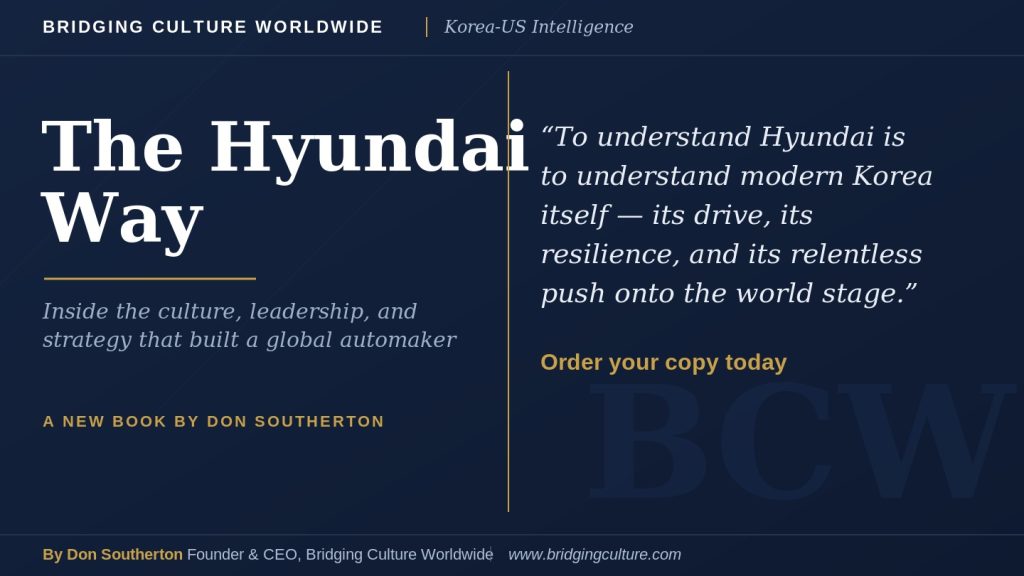
    New: The Hyundai Way is now available in Kindle, paperback, and hardcover. Inside the culture, leadership, and strategy that built a global automaker, the work-funneling model, the chaebol timeline, and the five transformation vectors reshaping Hyundai’s next decade.

    Order on Amazon: https://www.amazon.com/dp/B0GRPDFVNF

    If your team is weighing Korea exposure this year, this is the lens I bring to client work. Reply if you’d like to talk.

    Join Our LinkedIn Newsletter

    Stay in the loop on Korea-US business. Get the briefing and more, free. Subscribe here: Korea Facing
  • Korea-US Trade & Investment Briefing

    BCW Daily Briefing

    Tuesday, June 9, 2026

    Headline Nvidia’s 260,000-chip Korea supply deal anchors the AI buildout.

    Top Story

    Korea’s Industry and Trade Minister Kim Jung-kwan said he received renewed US confirmation that tariffs on Korea will not exceed the agreed 15%, holding an emergency meeting to calm market jitters.

    The reassurance matters because semiconductors and pharma carry most-favored-nation protection under the deal, shielding Samsung and SK hynix from worst-case Section 232 outcomes.

    Sector Watch

    Semiconductors: Samsung began shipping samples of its newest HBM chip, moving ahead of rivals on the memory critical to AI data centers.

    Automotive/AI: Nvidia confirmed it will supply 260,000+ advanced AI chips to Korea’s government and firms including Samsung and Hyundai Motor Group.

    BCW Take

    The 15% cap and carve-outs gives Korean chipmakers rare tariff visibility; the real leverage now shifts to who locks in Nvidia and US shipbuilding contracts first.

    New: The Hyundai Way is now available in Kindle, paperback, and hardcover.
    Inside the culture, leadership, and strategy that built a global automaker, the work-funneling model, the chaebol timeline, and the five transformation vectors reshaping Hyundai’s next decade.
    Order on Amazon: https://www.amazon.com/dp/B0GRPDFVNF
    If your team is weighing Korea exposure this year, this is the lens I bring to client work. Reply if you’d like to talk.

    Join our LinkedIn Newsletter
    Stay in the loop on Korea-US business. Get the briefing and more, free.
    Subscribe here: Korea Facing

  • US reaffirms Korea tariff cap stays at 15% as the won slides to a 17-year low

    US reaffirms Korea tariff cap stays at 15% as the won slides to a 17-year low

    Monday, June 8, 2026 | Bridging Culture Worldwide

    Headline: US reaffirms Korea tariff cap stays at 15% as the won slides to a 17-year low.

    Top Story

    Korea’s Industry and Trade Minister Kim Jung-kwan said Seoul received renewed US confirmation that tariffs on Korean goods will not exceed the 15% agreed last year, after talks with USTR on the margins of the OECD ministerial in Paris. It locks in the autos cut from 25% to 15% and keeps the $150B shipbuilding / $200B industrial investment framework on track. Seoul Economic Daily

    Trade & Tariff

    Both sides reaffirmed the existing deal; Korea stressed the “balance of benefits” must hold. Semiconductors remain on “no less favorable” terms versus peer competitors. Watch for the formal chip-tariff schedule pending since January.

    Sector Watch

    Semiconductors: Samsung and SK hynix memory stay in focus under the pending US semiconductor tariff track. Automotive: the 15% auto/parts rate (down from 25%) is the deal’s biggest near-term win for Hyundai and Kia.

    Biopharma: quiet, no material 24-hour development.

    Korean Corporate Tracker

    Post-deal domestic commitments still anchor the picture: Samsung 450T won ($310B) over five years incl. a new Pyeongtaek line; Hyundai 125T won ($86.3B) 2026-2030 R&D; SK at least 128T won ($88.3B) through 2028, AI-focused.

    Hanwha Watch

    Hanwha is actively weighing a second US shipyard on top of its $5B Philly Shipyard build-out, eyeing US Navy submarine and LNG-carrier work as it scales toward 20 vessels/year.

    KRW / Financial Signal

    USD/KRW rose to ~1,560 on June 5, the won’s weakest since 2009, down ~7.9% on the month on Middle East risk sentiment. A weaker won cushions Korean exporters against the 15% tariff but raises imported-input costs.

    BCW Take

    The 15% ceiling holding plus a 17-year-low won means Korean exporters have rare tailwind room right now; the open question is how the still-unwritten chip tariff schedule lands.


    New: The Hyundai Way is now available in Kindle, paperback, and hardcover.

    Inside the culture, leadership, and strategy that built a global automaker, the work-funneling model, the chaebol timeline, and the five transformation vectors reshaping Hyundai’s next decade.

    Order on Amazon: https://www.amazon.com/dp/B0GRPDFVNF

    If your team is weighing Korea exposure this year, this is the lens I bring to client work. Reply if you’d like to talk.


    Join our LinkedIn Newsletter

    Stay in the loop on Korea-US business. Get the briefing and more, free.
    Subscribe here: Korea Facing

  • Korea-US Week in Review, June 1-5, 2026

    Korea-US Week in Review banner

    Korea spent the week cementing its place at the center of the global AI-hardware stack while locking down the most important number in the trade file: a 15% tariff ceiling. Not to mention, Nvidia's Jensen Huang touring Seoul to court the chaebol on AI chips and data centers.

    Top Stories

    1. Huang's Seoul Tour Puts Korea at the Center of the AI Stack

    Fresh off GTC and Computex, Nvidia CEO Jensen Huang landed in Korea (June 4–5) to meet SK's Chey, Hyundai's Euisun Chung, LG's Koo Kwang-mo, and Naver's Lee Hae-jin on sovereign AI, data centers.

    Impact: Expect concrete chip and data-center commitments to follow. Korea's conglomerates are positioning as core nodes in Nvidia's global AI stack.

    2. 15% Tariff Ceiling Confirmed

    Korea secured US confirmation that tariffs will not exceed the agreed 15% ceiling. Trade Minister Kim Jung-kwan met Commerce Secretary Lutnick to settle uncertainty after a new Section 301 forced-labor probe (up to 12.5% on select goods) emerged.

    Impact: The 15% ceiling holding is the single most important signal for Korea-US deal flow this quarter.

    3. Samsung's Memory Lead Drives the AI-Memory Cycle

    Samsung began shipping samples of its newest HBM chip, moving ahead of rivals on memory critical to AI data centers, and surpassed Micron as the world's largest automotive memory supplier.

    The global chip market is on track for $975B in 2026, up 26% on AI demand. Samsung, SK Hynix, and Micron also joined Anthropic's $65B Series H as strategic infrastructure partners.

    4. Hanwha's US Industrial Play Advances

    Hanwha Philly Shipyard's $5B transformation is underway, targeting up to 20 vessels/year and 7,000 jobs.

    Hanwha Defense USA and Magnet Defense partnered on medium unmanned surface vessels (MUSVs) and robotic shipyards, and the US Naval Institute's June Proceedings featured Philly Shipyard as a model for allied industrial cooperation. A Pine Bluff Arsenal (Arkansas) lease paves the way for a $1.3B Hanwha energetics facility.

    5. Biopharma: Korea Becomes a Strategic Anchor

    Samsung Biologics has risen to global Top 3, with foreign capital flowing into Lotte Biologics, Celltrion, and SK pharmteco.

    Global pharma majors now treat Korea as a strategic anchor, not a low-cost vendor.

    BCW Take

    This was the week Korea's AI-hardware centrality and its trade-deal stability converged. The 15% ceiling gives clients a stable planning baseline; the forced-labor probe is the variable to watch. Huang's visit signals that the chaebol are no longer just suppliers, they are infrastructure partners in the West's AI buildout.

    New from Don Southerton

    My new book, Hyundai Way: Transformation, is now available in Kindle, paperback, and hardcover. It maps how Hyundai Motor Group moved from fast follower to global game changer, the work-funneling model, the chaebol timeline, and the five transformation vectors (robotics, software-defined vehicles, autonomous driving, hydrogen, urban air mobility) reshaping its next decade.

    Order on Amazon: https://www.amazon.com/dp/B0GRPDFVNF

    An Amazon review goes a long way, too.

  • The Signature Paradox: Why Korean Partners Hesitate, and What Korean Law Actually Says

    Bridging Culture Worldwide | Client Advisory

    Over more than twenty years working with Korean companies, I have repeatedly run into what I call the paradox. Korean partners are enthusiastic about a collaboration, have invested months building the relationship, and clearly see the mutual benefit. Yet when it comes time to sign agreed-upon documents they hesitate, or simply don’t sign.

    Western companies find this baffling. From their side, these agreements are routine steps that protect everyone and demonstrate good faith. They are caught off guard when partners who seemed eager suddenly go quiet once the paperwork arrives. The instinct is to read it as cold feet about the deal. It usually isn’t. The reluctance rarely reflects doubt about the relationship or commitment to the project.

    Western executives tend to assume the Korean caution is irrational, a cultural quirk to be managed around. Korean commercial law suggests otherwise. Korea operates under a civil-law system, and Korean contract law has no consideration doctrine. Under the Korean Civil Act, a properly formed agreement is binding even without the exchange of value that common-law systems require. Korean courts will enforce gratuitous promises if they are formed correctly.

    The practical implication is significant, and most U.S. lawyers do not know it: a document labeled “non-binding,” an MOU or a letter of intent, may already constitute an enforceable contract under Korean law, whether or not either party intended it that way. It is a reasonable response to a legal system where the signature, not the consideration, does the binding.

    The weight an MOU carries in Korea works on three layers at once. Legally, under the no-consideration rule above, it may already be a contract. Culturally, a signed MOU represents a decision taken at the leadership level with organizational commitment behind it; walking it back signals that your word cannot be trusted, which in a relationship-driven business culture outlasts the deal. Reputationally, Korea’s senior business community is smaller and more interconnected than most U.S. executives realize; a company that treats MOUs as disposable will find future Korean partners more guarded and more demanding of ironclad terms upfront.

    The mirror image: the Western “immutable contract” assumption is also partly wrong

    If the Korean side underestimates Western comfort with paper, the Western side overestimates the finality of its own contracts in a Korean context. I was once told that in Korea the purpose of signing a contract is to formalize the partnership, and that over time the terms would be subject to change and renegotiation. In the West, a signed agreement is treated as immutable. In Korea, the contract solidifies the working relationship, and the relationship is expected to keep adjusting the terms to reflect business conditions.

    Korean law reinforces this. Good faith is not merely a canon of interpretation in Korea. Under Article 2 of the Civil Act it is a positive legal obligation enforceable in court. Korean courts interpret contracts based on the parties’ actual intent and good faith, where U.S. courts apply an objective standard.

    Two more features compound the effect. The Standard Terms Regulation Act (STRA): standardized “boilerplate” terms are not automatically enforceable in Korea, even in B2B contracts and even when signed. Surprising clauses the counterparty could not reasonably have anticipated, and terms that exclude rights granted by Korean mandatory statutes, can be void. The party supplying the standard terms must specifically call attention to unusual or onerous clauses before signing, or risk losing them. This is one reason Korean teams question boilerplate that Western counsel consider settled. The questioning is not obstruction; under STRA it can be necessary.

    Mandatory rules override your choice of law. Even a contract governed by New York or English law remains subject to certain Korean mandatory rules where Korean operations, Korean personal data, or Korean-designated technology are involved, including the Serious Accident Punishment Act, PIPA, the Korea Fair Trade Act (KFTA), and the National Core Technology framework. KFTA in particular has real extraterritorial reach: the Korea Fair Trade Commission has investigated foreign firms for effects in the Korean market even when the conduct originated abroad, and exclusivity and pricing terms drafted as routine in the U.S. can run into KFTA’s unfair-trade provisions.

    After the ink dries: reinterpretation and personnel turnover

    Perhaps more concerning than the negotiation itself is what happens afterward. Terms mutually agreed within a binding agreement can be reopened. As Korean team members rotate onto the project, new staff are unfamiliar with prior compromises and understandings. Responding to changing business conditions, they arrive with different expectations and press for fundamental changes that alter the agreement, requiring amendments, with all the associated time and cost. In the worst cases, the Western company refuses to alter what it considers fair and binding, and the relationship is seriously jeopardized.

    Two structural realities make this slower than Western teams expect. Korean management is highly hierarchical: the working-level staff who negotiate the terms often lack authority to sign, and approval from senior leadership adds layers of delay. These matters are frequently elevated to quarterly Board of Directors meetings, turning what Western companies see as routine administrative steps into executive-level agenda items. Even after agreements are signed, getting the executed copies returned can take weeks or months.

    A worked example, and how it was unblocked

    A very promising partnership once slipped from “sign by year-end” into a long, drawn-out ordeal. A bottleneck formed each time the Korean team proposed content revisions: changes had to be reviewed and approved by the American working-level team before the Korean team would submit them to its leadership; once Korean leadership approved, the changes went to the American legal counsel; and if counsel had edits, the whole cycle restarted.

    After analyzing the loop, I made two moves. First, I brought everyone into weekly conference calls to address the major concerns directly, with a second call scheduled as needed for the legal counsels alone. Second, I pressed both sides to recognize that the relationship was genuinely positive and sound despite the frustration, and stressed the need to compromise and minimize further revisions in order to reach a signed agreement. With all parties aligned, the project moved to signing in a timely manner.

    What this means in practice

    For Western companies, the takeaway is not to abandon documentation. It is to stop treating it as a neutral, friction-free formality. Build the relationship and the paperwork in parallel, expect a staged transition from informal understanding to written terms as trust deepens, and recognize that under Korean law the line between “non-binding” and “binding” is blurrier than your standard playbook assumes.

    Get Korean counsel to confirm whether your “preliminary” document is in fact enforceable; flag your boilerplate proactively rather than waiting for it to be challenged under STRA; identify the Korean mandatory rules your deal engages at the drafting stage, not after a dispute; and budget for the hierarchy and board cycles that govern Korean sign-off.

    The patience this requires is not a cost of doing business in Korea. It is the business of doing business in Korea.


    Bridging Culture Worldwide advises U.S. and Korean companies on the intersection of Korean corporate culture, trade policy, and commercial law. Learn more at bridgingculture.com. This advisory is general information on cross-cultural and cross-border legal practice, not legal advice. Confirm specific questions with qualified counsel.

    New: The Hyundai Way is now available in Kindle, paperback, and hardcover. Inside the culture, leadership, and strategy that built a global automaker, the work-funneling model, the chaebol timeline, and the five transformation vectors reshaping Hyundai’s next decade. Order on Amazon.

    Join our LinkedIn Newsletter — Korea Facing. Stay in the loop on Korea-US business. Get the briefing and more, free.