Category: news

  • Korea-US Intelligence Briefing

    Korea-US Intelligence Briefing

    Listen to the audio version

    Headline
    Hanwha doubles down on US shipbuilding

    Top Story
    At IndoPac 2026, Hanwha’s CEO said Korean shipbuilding strength is now firmly rooted in Philadelphia, where the workforce has grown from hundreds to over 2,000 since the Philly Shipyard acquisition. Hanwha just won its first US Navy contract for the Next-Generation Logistics Ship design and is building MARAD multi-mission vessels, with a $5 billion plan to lift annual output toward 20 vessels.

    This is the clearest signal yet that the $150 billion Korea shipbuilding commitment is converting into US jobs and naval capacity.

    Trade & Tariff
    The 10 percent Section 122 tariff on Korean goods is set to expire around July 24, 2026, the 150-day statutory limit. The Court of International Trade ruled it unlawful in May, but collection continues under a Federal Circuit stay pending appeal. Watch for whether the administration lets it lapse or pivots to Section 301/232 authority.

    BCW Take
    The shipbuilding story is the durable one: tariffs may lapse, but Hanwha’s Philadelphia footprint and Navy contracts are structural bets that outlast any single trade ruling.

    BCW Client Spotlight: GUNSENS


    GUNSENS is a Silicon Valley public-safety platform bringing AI-powered gun threat detection. Its devices detect a gun threat and cut emergency response from minutes to seconds.

    The design, and the technology, sits in the AI, mobility, and safety-technology lanes that strategic investors are actively funding.

    Learn more: www.gunsens.com


    Overview: GUNSENS deck


    Contact: Don Southerton, dsoutherton@bridgingculture.com

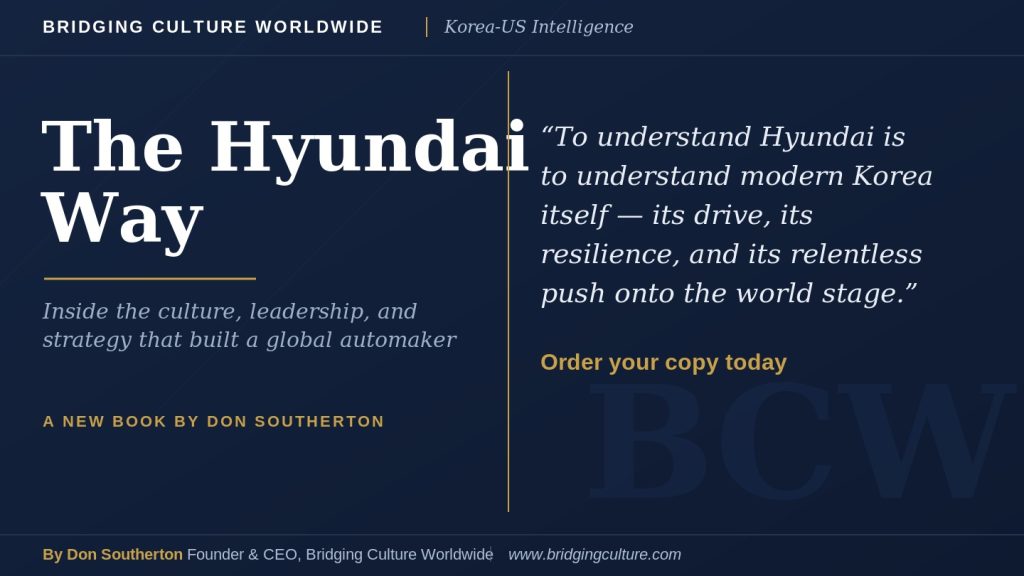
    New: The Hyundai Way is now available in Kindle, paperback, and hardcover.
    Inside the culture, leadership, and strategy that built a global automaker, the work-funneling model, the chaebol timeline, and the five transformation vectors reshaping Hyundai’s next decade.

    Hyundai


    Order on Amazon: https://www.amazon.com/dp/B0GRPDFVNF

    Twenty-plus years on Korea-US. The fundamentals don’t change; the stakes do. I take on only a handful of clients at a time; by choice.

    If your team is weighing Korea exposure this year, this is the lens I bring to client work. Reply if you’d like to talk.  DM 310-866-3777

    Don  Southerton

    Don Southerton, Bridging Culture Worldwide
  • AI Deployment Without Governance Infrastructure

    AI Deployment Without Governance Infrastructure
     Listen to the audio version

    Saturday, June 27, 2026
    This paper defines the national security interests at stake, sets forth the architectural requirements enabling democratic AI deployment, and positions the United States as the democratic nation best positioned to lead and coordinate the delivery of a complete solution.

    AI Deployment Without Governance Infrastructure: The National Security Threat Inside America’s AI Leadership.

     Why frontier leadership without deployment governance infrastructure is an incomplete and vulnerable strategy.

    Kenneth Herfurth, Founder and Chief Executive Officer, Ander LLC, June 2026


    Abstract

    This paper is submitted in direct response to the Executive Order Promoting Advanced Artificial Intelligence Innovation and Security, signed June 2, 2026, and specifically to the mandate under Section 2(e) directing the Director of the Office of Management and Budget to determine within 30 days whether any federal grant programs have available funding that can be directed toward applicants developing advanced AI vulnerabilit
    y detection.

    To lead artificial intelligence, a nation must lead on two tracks simultaneously. Track One is the production capacity of the AI era: frontier model development, hyperscale data center infrastructure, the energy supply that powers it, and the semiconductor design that makes it possible. Track Two is the infrastructure AI deployment runs on: the governance infrastructure that makes frontier AI capability safe, accountable, and absorbable by the enterprises, governments, and critical infrastructure operators it is meant to serve.

    The United States leads Track One. Every major democratic economy has enacted or advanced deployer liability frameworks. None has built the infrastructure stack that makes those frameworks satisfiable at the deployment layer.

    That asymmetry is a market gap revealing a consequential national security vulnerability.Six forces are converging at the deployment gap: courts establishing deployer liability; insurers withdrawing coverage for ungoverned AI deployments; a fragmented regulatory landscape (EU AI Act, Korea AI Basic Act, and more than a dozen inconsistent US state laws); capital flowing overwhelmingly to the supply side; deployers structurally unprepared to govern what they deploy; and the technical convergence of AI deployment scale with the quantum cryptographic transition deadline.

    The paper concludes with a framework of architectural requirements that any AI deployment governance infrastructure must satisfy to enable democratized AI: the capability for enterprises, governments, and citizens to deploy AI on their own constitutional and sovereign terms, governing their own corpus by their own declared authorities.

    BCW Client Spotlight: Ander.ai

    Ander.ai is an enterprise AI governance company building IPX, an IP Transaction Ledger that sits between an organization’s AI Governance Office and its live AI systems. In plain terms, the enterprise declares its policy, legal, regulatory, and ethical boundaries once, and IPX enforces that framework on every AI output, at AI speed and at scale.What makes it different is standing.

    Ander treats AI governance as a corporate governance function with the same weight as financial controls, not a compliance layer added on top of deployment. Boards and executive leadership set the boundaries, the AI Governance Office defines the framework, and IPX implements and operates it.The payoff for the enterprise is evidence on demand. Every governance decision, authorization, and AI output is written to a tamper-evident ledger, so regulatory compliance proof and audit response become a query, not a fire drill. The system also surfaces governance drift before it becomes a liability.

    Bridging Culture Worldwide is engaged with Ander.ai on its growth and market positioning, with an investor-and-enterprise lens on a category, AI governance infrastructure, that is moving from optional to mandatory.


    Ander.ai: govern your enterprise AI at AI speed.

     Most companies can deploy AI in weeks. Almost none can prove, on demand, that every AI decision stayed inside the rules their board set. If your AI is already in production and your governance still lives in slides, let’s talk.

    Contact: Don Southerton, dsoutherton@bridgingculture.com
  • Korea-US Trade & Investment Intelligence Briefing

    Friday, June 19, 2026

    Korea-US Trade & Investment Intelligence Briefing

    Headline: Won slides back towards 1,540 per dollar

     Listen to the audio version

    TOP STORY

    A softer won helps Korean exporters on price but raises the bar for the large US capital commitments Korean firms have pledged. Expectations that the Bank of Korea stays tighter for longer are limiting the downside.

    SECTOR WATCH

    Potential chip tariffs remain the central exposure for Samsung and SK hynix memory. Autos have relief at 15 percent, supporting Hyundai’s US pricing.

    KOREAN CORPORATE TRACKER

    Standing domestic capital map under the current tariff deal: Samsung 450 trillion won (about 310 billion dollars) over five years including a new Pyeongtaek line; Hyundai 125 trillion won (about 86 billion dollars) 2026-2030 for R&D, AI, robotics and autonomy; SK at least 128 trillion won (about 88 billion dollars) through 2028, AI-focused.

    BURGER WATCH

    Shake Shack opened 2026 with a K-Shack menu, including K-Shack Fried Chicken Bites and a first-ever spicy caramel shake, leaning into Korean flavors stateside. Mom’s Touch keeps expanding drive-throughs as the value-burger trend pressures premium K-burger players.

    BCW TAKE

    A weaker won will front-load US investment while Korea quietly presses Washington for semiconductor tariff parity. Clients with Korea exposure should plan for currency and tariff volatility through the summer.

    A quick note on our cadence: we offer the Korea-US Trade & Investment Intelligence Briefing Monday through Friday, a special Week in Review on Sunday, and a variety of topics on Saturday.

    We’re always open to your questions, and please share any posts, and text me if you’d like to chat, 310-866-3777

  • Korea-US Trade & Investment Intelligence Briefing: Thursday, June 18, 2026

    Korea-US Intelligence Briefing

    Headline: Won slides against the dollar.

     Listen to the audio version

    Top Story
    The won weakened to about 1,533 per dollar, its softest level in months. A weaker won cushions Korean exporters on price but raises import and dollar-financing costs, and it lands just as Korean firms ramp up large US capital commitments.

    Trade & Tariff
    Seoul reaffirmed that US tariffs on Korean goods will not exceed the agreed 15%, after trade chief Kim Jung-kwan and negotiators met USTR Jamieson Greer. Autos and parts hold at 15%, and semiconductors are to be treated on terms no less favorable than peers.

    Korean Corporate Tracker
    The post-deal domestic investment wave still anchors the story: Samsung ~450 trillion won over five years (Pyeongtaek expansion), Hyundai Motor Group ~125 trillion won 2026-2030 (R&D, AI, robotics, autonomy), and SK at least ~128 trillion won through 2028. US-facing capex now competes with these domestic commitments amid a weaker won.

    BCW Take
    With the 15% ceiling holding but the won sliding, the smart move is to lock US project pricing and dollar exposure now rather than wait for further currency drift.

    New: The Hyundai Way is now available in Kindle, paperback, and hardcover.
    Inside the culture, leadership, and strategy that built a global automaker, the work-funneling model, the chaebol timeline, and the five transformation vectors reshaping Hyundai’s next decade.

    hyundai way book


    Order on Amazon: https://www.amazon.com/dp/B0GRPDFVNF
    If your team is weighing Korea exposure this year, this is the lens I bring to client work. 

    Reply if you’d like to talk. Text 310-866-3777

    Join our LinkedIn Newsletter
    Stay in the loop on Korea-US business. Get the briefing and more, free.
    Subscribe to Korea Facing