Tag: kia

  • Hyundai and Kia Motors, 2026 Edition

    US-Korea-Global Week in Review–New Book, too.

     Listen to the audio version

    The week of July 20 to 24 ended with the tariff question answered, and not the way Seoul and others wanted. Washington set a new floor, Korea, for example, kept its previous ceiling.

    Forced-labor tariff landed at 12.5 percent. USTR issued its final Section 301 action Thursday covering Korea, Japan, Switzerland and 57 other economies, effective July 24.

    For Korea it works as a floor, topping products up to 12.5 percent rather than adding 12.5 across the board. Seoul has held the 15 percent ceiling on cars. Washington reaffirmed that Korean goods should not exceed the negotiated bilateral rate. Section 232 metals stay capped at 15 percent through 2027. Pharma and semiconductor carve-outs are still being negotiated.

    BCW Take

    Globally, the 12.5 percent forced-labor floor is the number to plan around now. It is not catastrophic, but it resets the base under every other trade conversation, and clients with EU, China, or Vietnam-adjacent supply chains sit in the same bucket.

    The bigger story is the trade: Korea has bought its 15 percent ceiling with capital planted on American soil. Shipbuilding, energy, and chips are the currency.

    Cadence: Briefing Mon-Fri, Sunday Week in Review, plus special updates most Saturdays.

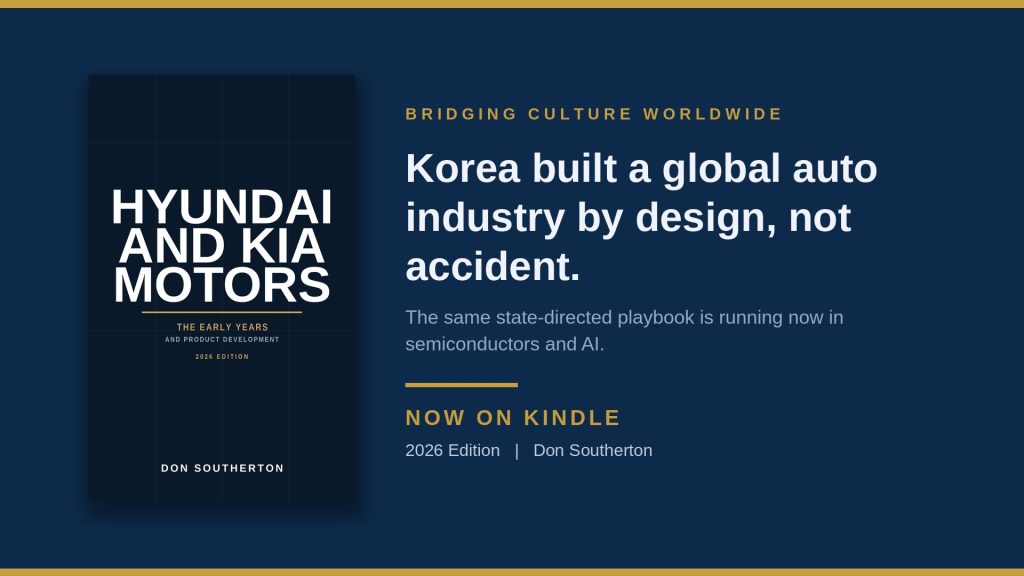
    New on Kindle: Hyundai and Kia Motors, 2026 Edition

    I have revised and reissued my 2012 history of how South Korea built a global automotive industry. It runs from Hyundai’s first Ford assembly agreement in 1967 through the Pony and the Excel, Kia’s rise from three-wheel trucks to the Festiva and Sephia, the IMF Crisis, and the merger and quality turnaround that followed.

    The 2026 edition adds an afterword on why this matters now. The state-directed export playbook that built the car industry is the same one running today in semiconductors and AI.
  • Hyundai and Kia Motors: The Early Years and Product Development

    Hyundai and Kia Motors: The Early Years and Product Development

     Listen to the audio version

    Cadence: Briefing Mon-Fri, Sunday Week in Review, plus special updates most Saturdays.

    I am in the process of updating after nearly 15 years. The book examines the origin of not only Hyundai and Kia, but Korean industry. Look for future updates on its release in Kindle and paperback.

    From 2012,

    Author Don Southerton Announces Hyundai and Kia Motors: The Early Years and Product Development

    Author Don Southerton has announced the release of a new publication Hyundai and Kia Motors: The Early Years and Product Development. The Book provides deep insights into the rise of the South Korean car industry.

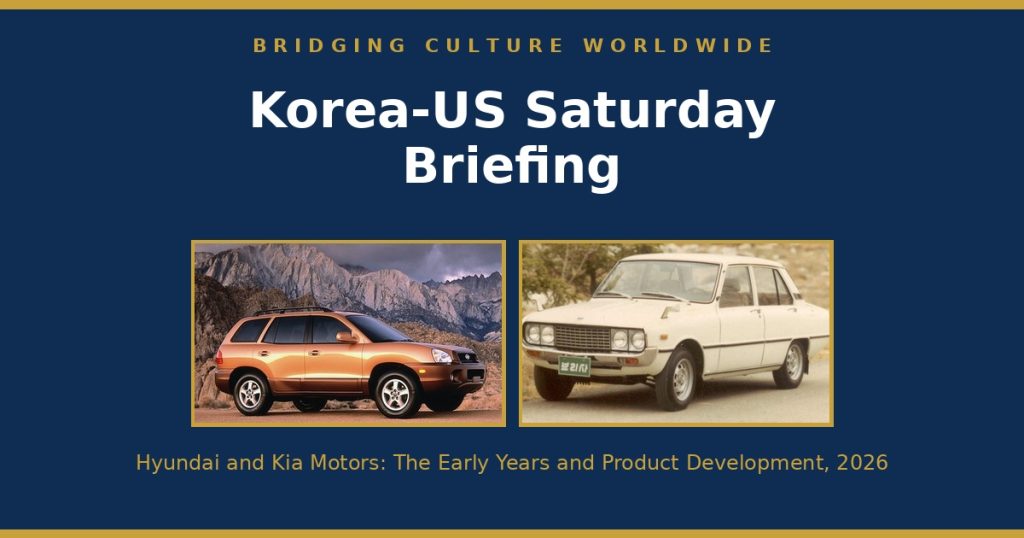
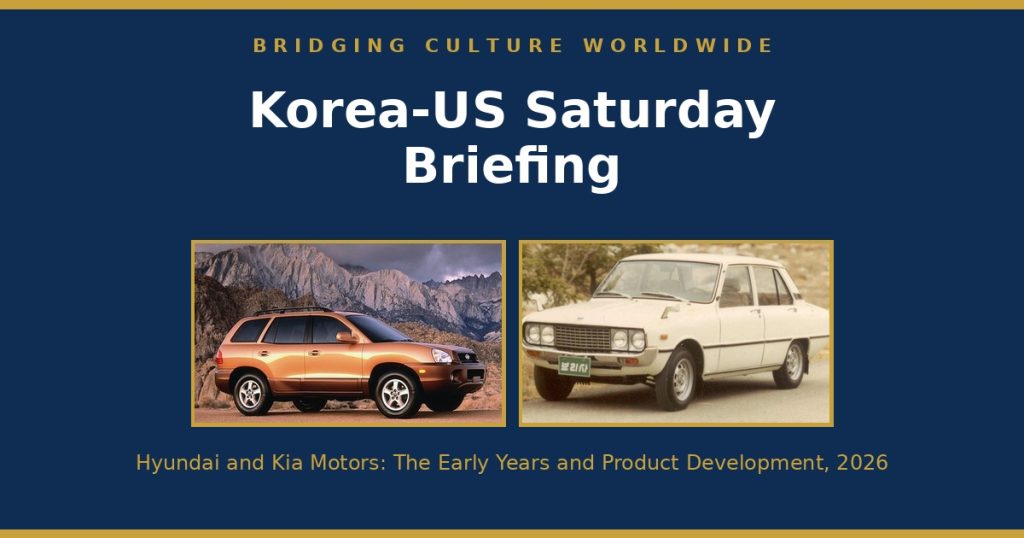
    Southerton’s latest writing weaves first-hand accounts of the challenges experienced by Korean management during the first years of Korean car production with the development of specific models, such as Kia’s Brisa, Pride, Sephia, Sportage and Rio plus Hyundai’s Pony, Excel, and Santa Fe

    Southerton notes, “Today we are witnessing a remarkable transformation in Hyundai and Kia brand image and sales are at record pace. This accomplishment was decades in the making. Hyundai and Kia Motors: The Early Years and Product Development shares the story behind this success.”

    Hyundai and Kia Motors: The Early Years and Product Development
  • Korea-US Week in Review

    Korea-US Week in Review

     Listen to the audio version

    Top story: Korea’s chaebol went all-in on domestic AI, mobility and defense, a 312 trillion won ($204B) wave of investment landed on top of a settled 15% tariff regime, while Hyundai posted its best-ever June in the US.

    The week’s throughline: Korean top groups are building at home and on American soil at the same time.

    Chips & AI, Korea doubles down at home

    President Lee opened the week unveiling a $576 billion semiconductor and AI investment drive, anchored by Samsung and SK Hynix’s combined ~800 trillion won for new southwest fabs.

    Midweek, SK Hynix moved to list an ADR on Nasdaq (SKHY) around July 10, raising up to ~$29B to fund chip infrastructure tied to US demand, the clearest signal yet of Korea buying US capital access. An ADR represents shares of a foreign company and allows international stocks to be easily bought and traded on U.S. exchanges like the NYSE or Nasdaq.

    Trade & tariffs

    The 15% reciprocal rate held all week, with Seoul citing US reassurance it will go no higher.

    Battery makers (LG Energy Solution, Samsung SDI, SK On) are pursuing tariff refunds after February’s Supreme Court ruling, while Hyundai is staying cautious on refund claims to avoid friction with the Trump administration.

    We are watching the Section 122 10% tariff, set to lapse around July 24.

    Autos, Hyundai’s record run

    Hyundai posted its best-ever June in the US (77,555 units, +11% YoY), capping record Q2 and first-half results and putting it on pace for a fourth straight annual US sales record.

    Kia also set a June record.

    The run is hybrid- and crossover-led, winning share on product mix, not price.

    Hyundai’s bet in future mobility

    Capping the week, Hyundai and Hanwha unveiled a combined 97 trillion won investment for southeastern Korea, part of a 312 trillion won conglomerate wave announced Friday in Jinju.

    Hyundai committed 42 trillion won over 10 years to turn the Gyeongsang region into a hub for AI-defined vehicles, advanced manufacturing, aerospace and clean energy, centered on a new Ulsan EV plant, Level 4+ autonomy, Mobis/Wia EV-component lines, advanced air mobility (Supernal), lunar rovers, SMRs and hydrogen.

    As a friend shared, “I believe the next wave of space hardware will be landers but right after that will be ground vehicles.”

    That said, Hanwha added 55 trillion won for integrated AI space infrastructure.

    The BCW Take

    This was the week Korea’s strategy came fully into view: with the 15% tariff floor now a planning constant, the action is positioning.

    Korea’s chaebol are pouring capital into home-soil AI, chips, mobility and defense while simultaneously planting flags on American ground, SK Hynix’s Nasdaq listing and Hanwha’s Philadelphia yard on one side, and the 312 trillion won domestic build-out on the other.

    For clients with Korea exposure, this is the moment to lock US-side capacity and supply-chain footing while Korean balance sheets stay aggressive.

    Question? DM 310-866-3777