I curate and offer this Briefing daily, as well as a Sunday ‘Week in Review,’ plus special updates most Saturdays. I plan to expand my coverage to a more global US-Korea-Global perspective.
TOP STORY The Korea International Trade Association (KITA) is asking the USTR to delay or cut a planned 12.5% Section 301 tariff on Korean goods, on top of the 10% Section 122 tariff set to expire around July 24.
LG says tariff uncertainty could delay its $28B US battery investment unless materials get an exemption.
Top headline: Samsung and Hyundai Motor headline a combined 312 trillion won ($201.7B) domestic investment wave with Hanwha and SK.
Top Story South Korea’s Finance Ministry announced July 3 that Hanwha, Hyundai Motor, Samsung, and SK Group will invest a combined 312 trillion won ($201.7B) in the southeastern Yeongnam region, targeting AI, small modular reactors, and next-gen chips.
Analysts warn the domestic tilt could draw fresh US trade pressure, since Washington wants that capital flowing into American plants, not Korean ones.
Korean Corporate Tracker Samsung and Hyundai Motor: 102 trillion won for Yeongnam robotics, batteries, and mobility AI. SK Group: 140 trillion won toward a 2GW AI data center with unnamed overseas partners. LG Group: 9.4 trillion won for appliance R&D and semiconductor substrates.
BCW Take Korea’s conglomerates are betting big at home just as Washington wants that capital pointed at US soil, a mismatch that will keep tariff and defense-procurement friction alive through the summer.
That said, South Korea’s June exports just hit a massive milestone, breaking the $100 billion mark in a single month for the first time in history. Only three other nations have ever done this before: Germany, the USA, and China. Even Japan has never done this.
According to the Ministry of Trade’s report for June 2026, exports skyrocketed 70.9% year-on-year, reaching an eye-popping $102.25 billion. The previous record was made a month ago in May at $87.8 billion, meaning Korea skipped the $90 billion mark and jumped straight into the 100-billion club.
While semiconductors get the most credit with chip exports nearly tripling compared to last June, bringing in $44.82 billion, auto exports grew 5.8% to $6.71 billion. Shipbuilders did well also, with ship exports climbing.
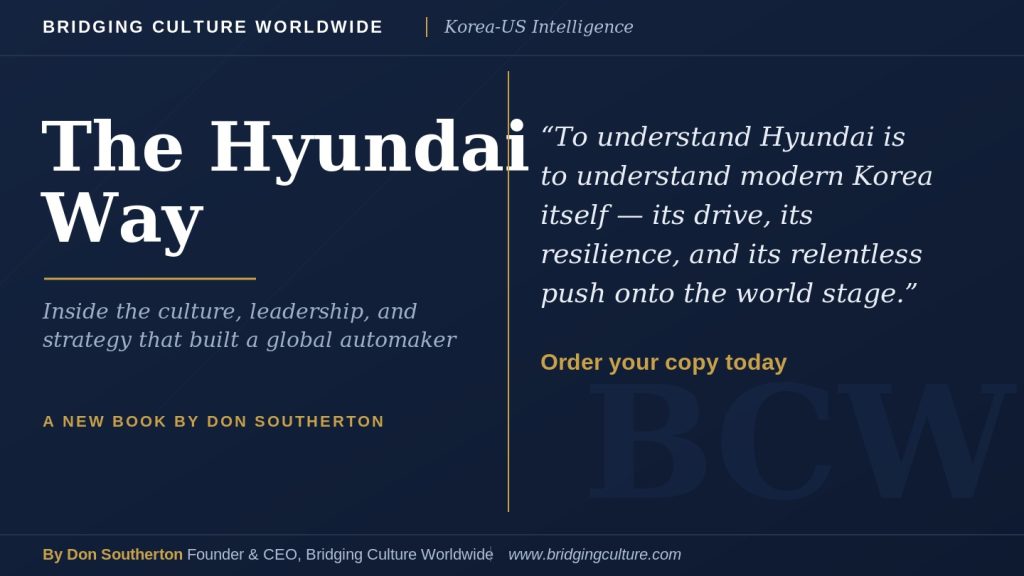
The Hyundai Way is now available in Kindle, paperback, and hardcover. Inside the culture, leadership, and strategy that built a global automaker, the work-funneling model, the chaebol timeline, and the five transformation vectors reshaping Hyundai’s next decade.
Top story: Korea’s chaebol went all-in on domestic AI, mobility and defense, a 312 trillion won ($204B) wave of investment landed on top of a settled 15% tariff regime, while Hyundai posted its best-ever June in the US.
The week’s throughline: Korean top groups are building at home and on American soil at the same time.
Chips & AI, Korea doubles down at home
President Lee opened the week unveiling a $576 billion semiconductor and AI investment drive, anchored by Samsung and SK Hynix’s combined ~800 trillion won for new southwest fabs.
Midweek, SK Hynix moved to list an ADR on Nasdaq (SKHY) around July 10, raising up to ~$29B to fund chip infrastructure tied to US demand, the clearest signal yet of Korea buying US capital access. An ADR represents shares of a foreign company and allows international stocks to be easily bought and traded on U.S. exchanges like the NYSE or Nasdaq.
Trade & tariffs
The 15% reciprocal rate held all week, with Seoul citing US reassurance it will go no higher.
Battery makers (LG Energy Solution, Samsung SDI, SK On) are pursuing tariff refunds after February’s Supreme Court ruling, while Hyundai is staying cautious on refund claims to avoid friction with the Trump administration.
We are watching the Section 122 10% tariff, set to lapse around July 24.
Autos, Hyundai’s record run
Hyundai posted its best-ever June in the US (77,555 units, +11% YoY), capping record Q2 and first-half results and putting it on pace for a fourth straight annual US sales record.
Kia also set a June record.
The run is hybrid- and crossover-led, winning share on product mix, not price.
Hyundai’s bet in future mobility
Capping the week, Hyundai and Hanwha unveiled a combined 97 trillion won investment for southeastern Korea, part of a 312 trillion won conglomerate wave announced Friday in Jinju.
Hyundai committed 42 trillion won over 10 years to turn the Gyeongsang region into a hub for AI-defined vehicles, advanced manufacturing, aerospace and clean energy, centered on a new Ulsan EV plant, Level 4+ autonomy, Mobis/Wia EV-component lines, advanced air mobility (Supernal), lunar rovers, SMRs and hydrogen.
As a friend shared, “I believe the next wave of space hardware will be landers but right after that will be ground vehicles.”
That said, Hanwha added 55 trillion won for integrated AI space infrastructure.
The BCW Take
This was the week Korea’s strategy came fully into view: with the 15% tariff floor now a planning constant, the action is positioning.
Korea’s chaebol are pouring capital into home-soil AI, chips, mobility and defense while simultaneously planting flags on American ground, SK Hynix’s Nasdaq listing and Hanwha’s Philadelphia yard on one side, and the 312 trillion won domestic build-out on the other.
For clients with Korea exposure, this is the moment to lock US-side capacity and supply-chain footing while Korean balance sheets stay aggressive.
Top Story At IndoPac 2026, Hanwha’s CEO said Korean shipbuilding strength is now firmly rooted in Philadelphia, where the workforce has grown from hundreds to over 2,000 since the Philly Shipyard acquisition. Hanwha just won its first US Navy contract for the Next-Generation Logistics Ship design and is building MARAD multi-mission vessels, with a $5 billion plan to lift annual output toward 20 vessels.
This is the clearest signal yet that the $150 billion Korea shipbuilding commitment is converting into US jobs and naval capacity.
Trade & Tariff The 10 percent Section 122 tariff on Korean goods is set to expire around July 24, 2026, the 150-day statutory limit. The Court of International Trade ruled it unlawful in May, but collection continues under a Federal Circuit stay pending appeal. Watch for whether the administration lets it lapse or pivots to Section 301/232 authority.
BCW Take The shipbuilding story is the durable one: tariffs may lapse, but Hanwha’s Philadelphia footprint and Navy contracts are structural bets that outlast any single trade ruling.
BCW Client Spotlight: GUNSENS
GUNSENS is a Silicon Valley public-safety platform bringing AI-powered gun threat detection. Its devices detect a gun threat and cut emergency response from minutes to seconds.
The design, and the technology, sits in the AI, mobility, and safety-technology lanes that strategic investors are actively funding.
New: The Hyundai Way is now available in Kindle, paperback, and hardcover. Inside the culture, leadership, and strategy that built a global automaker, the work-funneling model, the chaebol timeline, and the five transformation vectors reshaping Hyundai’s next decade.
The Signature Paradox: Why Korean Partners Hesitate, and What Korean Law Actually Says
Bridging Culture Worldwide | Client Advisory
Over more than twenty years of working with Korean companies, I keep running into the same paradox. A Korean partner is enthusiastic, has invested months in the relationship, and clearly sees the mutual benefit. Then the agreed documents arrive to be signed, and they hesitate, or simply do not sign.
Western teams read this as cold feet. It rarely is. The reluctance is usually not doubt about the deal. It is a reasonable response to how Korean law actually works.
Korea is a civil-law system with no consideration doctrine. Under the Korean Civil Act, a properly formed agreement is binding without the exchange of value that common-law systems require. The practical implication, which most U.S. lawyers miss: a document labeled “non-binding,” an MOU or a letter of intent, may already be an enforceable contract under Korean law, regardless of what either side intended. In Korea, the signature does the binding, not the consideration.
So a signed MOU carries weight on three layers at once. Legally, it may already be a contract. Culturally, it reflects a leadership-level decision with organizational commitment behind it, and walking it back signals that your word cannot be trusted. Reputationally, Korea’s senior business community is small and interconnected, and a company that treats MOUs as disposable will find future partners more guarded.
The mirror image is also true: the Western “immutable contract” assumption is partly wrong in Korea. There, signing formalizes the partnership, and the relationship is expected to keep adjusting the terms as conditions change. Korean law reinforces this. Good faith is not just a canon of interpretation; under Article 2 of the Civil Act it is an enforceable obligation. Two features compound the effect. Under the Standard Terms Regulation Act, boilerplate is not automatically enforceable even when signed, and surprising or onerous clauses must be specifically flagged or risk being void. And Korean mandatory rules, including PIPA, the Korea Fair Trade Act, and the National Core Technology framework, can override your choice of law where Korean operations, data, or technology are involved. The KFTA in particular can reach conduct that originates abroad.
BCW Take
After the ink dries, terms can be reopened. Staff rotate onto the project, arrive unfamiliar with prior compromises, and may press for changes. Korean management is highly hierarchical, the people who negotiate often cannot sign, and approvals can climb to quarterly board meetings. Even returning the executed copies can take weeks.
The takeaway is not to abandon documentation. It is to stop treating it as a friction-free formality. Build the relationship and the paperwork in parallel. Get Korean counsel to confirm whether your “preliminary” documents are already enforceable. Flag your boilerplate proactively rather than waiting for it to be challenged. Identify the Korean mandatory rules your deal engages at the drafting stage, not after a dispute. And budget for the hierarchy and board cycles that govern Korean sign-off.
The patience this requires is not a cost of doing business in Korea. It is the business of doing business in Korea.
BCW Client Spotlight: GUNSENS
GUNSENS is a Silicon Valley public-safety platform bringing privacy-first, AI-powered gun threat detection to Korea. Its devices detect a gun threat in under one second, with no cameras and no surveillance, and cut emergency response from minutes to seconds. The privacy-first design fits Korea’s PIPA framework, and the technology sits in the AI, mobility, and safety-technology lanes that Korean strategic investors are actively funding. The Bridging Culture Worldwide team is leading the GUNSENS Korea market entry and introductions.
Headline: Korean won closes above 1,540 per dollar, even as the KOSPI surges 3.4 percent on AI chip strength.
Top Story The won settled at 1,541.8 per dollar, its weakest close since March 2009, on a third straight session of dollar strength and Fed rate-hike expectations. The slide cuts both ways for Korea Inc.
On the plus side, a weaker won inflates the local-currency value of dollar revenue, padding margins for exporters like Hyundai, Kia, Samsung, and SK Hynix that bill US buyers in dollars, and it partly offsets the bite of US tariffs by making Korean goods cheaper abroad.
On the minus side, Korea imports nearly all of its energy and much of its raw materials in dollars, so input costs and imported inflation climb just as firms carrying dollar-denominated debt face heavier service costs.
Net read: a tailwind for the export P&L, a headwind for importers and balance sheets, and a flashing signal on capital flows worth watching.
Sector Watch Semiconductors: SK Hynix has overtaken Samsung as Korea’s most valuable company on HBM/AI demand, with shares up more than 340 percent this year. The KOSPI jumped 3.4 percent Wednesday on the chip rally.
Automotive: a weaker won lifts Hyundai/Kia US margins.
Hanwha A Senate Armed Services Committee defense bill (approved June 11) could let the US Navy procure up to two bulk fuel and two strategic sealift vessels from foreign shipyards, a potential opening for Hanwha Philly Shipyard.
Separately, Hanwha Aerospace became Korea’s first defense firm to win an S&P credit rating, A- stable, on June 22.
BCW Take A low won plus record AI-chip valuations is a split-screen Korea: pick your exposure deliberately, because the currency tailwind for exporters and the cost headwind for importers are now both real and widening.
New: The Hyundai Way is now available in Kindle, paperback, and hardcover.
Inside the culture, leadership, and strategy that built a global automaker, the work-funneling model, the chaebol timeline, and the five transformation vectors reshaping Hyundai’s next decade.
Order on Amazon: https://www.amazon.com/dp/B0GRPDFVNF
If your team is weighing Korea exposure this year, this is the lens I bring to client work. Reply if you’d like to talk.
Join our LinkedIn Newsletter Stay in the loop on Korea-US business. Get the briefing and more, free. Subscribe here
I’d like to offer you a complimentary one-on-one advisory chat. No agenda, no sales pitch, no strings attached. Just a direct conversation about whatever is on your mind, whether that’s Korea-US business, market shifts, leadership, or any decision you’re weighing.
As a member of our VIP group, you have an open invitation. I’m glad to make the time.
A quick note on our cadence: we offer the ‘Korea-US Trade & Investment Intelligence Briefing’ Monday through Friday, a special ‘Week in Review’ on Sunday, and a variety of topics, like this, on Saturday. We’re always open to your questions. Text 310-866-3777
A softer won helps Korean exporters on price but raises the bar for the large US capital commitments Korean firms have pledged. Expectations that the Bank of Korea stays tighter for longer are limiting the downside.
SECTOR WATCH
Potential chip tariffs remain the central exposure for Samsung and SK hynix memory. Autos have relief at 15 percent, supporting Hyundai’s US pricing.
KOREAN CORPORATE TRACKER
Standing domestic capital map under the current tariff deal: Samsung 450 trillion won (about 310 billion dollars) over five years including a new Pyeongtaek line; Hyundai 125 trillion won (about 86 billion dollars) 2026-2030 for R&D, AI, robotics and autonomy; SK at least 128 trillion won (about 88 billion dollars) through 2028, AI-focused.
BURGER WATCH
Shake Shack opened 2026 with a K-Shack menu, including K-Shack Fried Chicken Bites and a first-ever spicy caramel shake, leaning into Korean flavors stateside. Mom’s Touch keeps expanding drive-throughs as the value-burger trend pressures premium K-burger players.
BCW TAKE
A weaker won will front-load US investment while Korea quietly presses Washington for semiconductor tariff parity. Clients with Korea exposure should plan for currency and tariff volatility through the summer.
A quick note on our cadence: we offer the Korea-US Trade & Investment Intelligence Briefing Monday through Friday, a special Week in Review on Sunday, and a variety of topics on Saturday.
We’re always open to your questions, and please share any posts, and text me if you’d like to chat, 310-866-3777
Headline: Seoul pivots to record domestic investment.
Listen: Korea-US Briefing — June 17, 2026
Top Story
Under President Lee’s push to keep capital at home, the majors have unveiled large domestic programs: Samsung ~450 trillion won (5-yr), SK ~128 trillion won (through 2028), Hyundai 125 trillion won (2026–2030).
The signal: protect Korean R&D and fabs even as the US deal calls for $350B stateside.
BCW Take
Korea’s “invest at home” turn is partly a hedge against US tariff volatility.
New:The Hyundai Way is now available in Kindle, paperback, and hardcover — inside the culture, leadership, and strategy that built a global automaker: the work-funneling model, the chaebol timeline, and the five transformation vectors reshaping Hyundai’s next decade. Order on Amazon.
If your team is weighing Korea exposure this year, this is the lens I bring to client work.
Join our LinkedIn Newsletter: Stay in the loop on Korea-US business — get the briefing and more, free. Subscribe to Korea Facing.